For steel fabrication companies handling pressure vessels, tanks, pipes, structural components, and other large fabricated assemblies, welding productivity depends on more than the welding machine itself. The way a workpiece is positioned, rotated, and accessed can have a major impact on weld quality, production time, and operator efficiency. This is where a welding manipulator machine in UAE can make a practical difference. Designed to position the welding torch accurately along large or complex workpieces, welding manipulators can help fabricators improve consistency while reducing unnecessary repositioning and manual handling.
With the UAE continuing to promote advanced manufacturing and Industry adoption, automated and semi-automated welding equipment is becoming increasingly relevant for industrial manufacturers.
What Is a Welding Manipulator Machine?
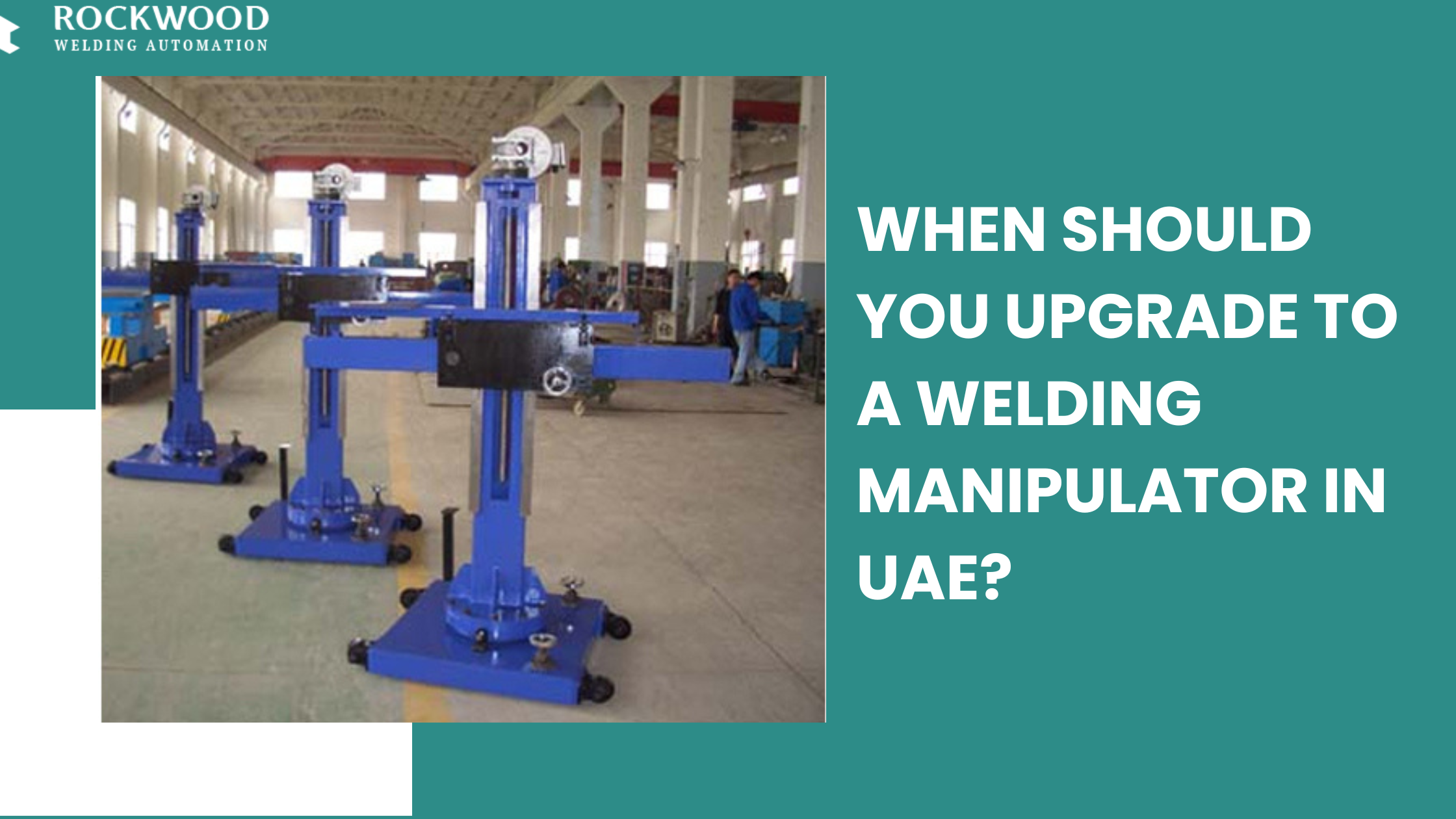
A welding manipulator is a mechanized system used to move and position a welding torch in relation to the workpiece. A typical column-and-boom manipulator consists of a vertical column and a horizontal boom that can move the welding head into the required position.
Depending on the configuration, the boom can provide vertical and horizontal movement, while the welding system controls torch travel and welding parameters.
For large fabrication applications, this arrangement allows the operator to position the welding head accurately without repeatedly moving the entire component.
Welding manipulators are commonly used for:
- Pressure vessels and storage tanks
- Large-diameter pipes
- Structural steel assemblies
- Cylindrical components
- Boilers and heat exchangers
- Wind tower sections
- Heavy industrial fabrication
5 Signs Your UAE Fabrication Business May Need a Welding Manipulator
1. Your Welded Components Are Becoming Larger
When component dimensions and weights increase, manually positioning the welding torch becomes more difficult. Operators may spend considerable time adjusting their position, moving platforms, or waiting for cranes and other handling equipment.
A welding manipulator in UAE can bring the welding torch to the work area instead of requiring continuous movement around a large component.
2. Long Weld Seams Are Taking Too Much Time
Longitudinal and circumferential welds can involve significant torch travel. Maintaining a consistent travel speed and torch position manually over long distances can be challenging.
A mechanized manipulator can provide controlled torch movement, helping maintain more consistent welding conditions throughout the seam.
3. Repositioning Is Reducing Productivity
Fabrication productivity is not determined only by arc-on time. Setup, repositioning, alignment, inspection, and handling can also consume valuable production hours.
A welding manipulator machine can reduce unnecessary torch repositioning and help create a more organized welding workflow.
Track metrics such as:
- Weld length per shift
- Setup time
- Arc-on time
- Repositioning time
- Rework percentage
- Operator hours per component
These figures can help determine whether mechanized welding would provide a worthwhile return.
4. Weld Consistency Is Becoming Difficult to Maintain
For repetitive fabrication, consistency is essential. Variations in torch angle, travel speed, and torch-to-work distance can affect the welding process.
A welding manipulator machine helps maintain controlled torch positioning and movement. When combined with appropriate welding parameters and skilled supervision, this can contribute to more repeatable welds.
5. Your Production Volume Is Increasing
If your company is moving from occasional fabrication to higher-volume production, manual welding methods may become a bottleneck.
The UAE’s Industry strategy emphasizes automation, productivity, digital transformation, and advanced manufacturing technologies. MoIAT’s Transform initiative is also supporting manufacturers in increasing digital maturity and adopting advanced technologies.
Welding Manipulator vs. Manual Welding
A welding manipulator does not replace the knowledge of a qualified welder. Instead, it provides controlled mechanical movement while the welding process is supervised and configured by trained personnel.
Manual welding can remain practical for:
- Small components
- Low production volumes
- Highly irregular assemblies
- Jobs requiring frequent manual access
A manipulator becomes more attractive when the application involves long welds, repetitive components, large workpieces, or demanding production schedules.
Combine Welding Manipulators With Welding Rotators
For cylindrical workpieces, a manipulator is often used together with Welding rotators in UAE.
A welding rotator supports and rotates the workpiece while the manipulator positions the welding torch. This combination can be particularly useful for tanks, pipes, pressure vessels, and other cylindrical fabrications.
Instead of manually moving around the component, the operator can coordinate controlled rotation with torch travel.
When selecting a rotator, consider the workpiece’s:
- Maximum weight
- Diameter range
- Length
- Surface condition
- Required rotation speed
- Type of welding operation
The correct combination of manipulator and rotator should be selected according to the actual dimensions and production requirements of the fabrication shop.
Where Does a Welding Positioner Fit?
A Welding positioner in UAE is another useful automation solution, particularly when components need to be tilted or rotated into a more suitable welding position.
Positioners can be useful for smaller or medium-sized assemblies where controlled workpiece positioning is more practical than moving the welding torch over a large structure.
The choice between a welding manipulator machine, rotator, or positioner depends on the geometry, weight, dimensions, welding orientation, and production requirements of the component.
Don’t Ignore Welding Accessories and Consumables
Automation equipment is only one part of a reliable fabrication operation. Supporting products also influence the overall workflow.
For projects involving insulation and attachment applications, working with an experienced Insulation pin supplier in Dubai can help fabrication companies source suitable insulation pins and related fastening solutions for their requirements.
The objective should be to build a complete production workflow rather than purchasing individual machines without considering how they work together.
How to Calculate the Potential ROI
Before investing in a welding manipulator machine, compare your current production figures with the expected mechanized workflow.
Consider:
Potential productivity gain = Reduced production time + Reduced repositioning time + Lower rework time
Also evaluate equipment utilization, operator requirements, consumable consumption, maintenance costs, and expected production volume.
For a company producing large quantities of similar components, even modest reductions in cycle time can become significant over hundreds of production cycles.
Choose the Right Welding Manipulator Machine for Your Application
There is no single manipulator configuration suitable for every fabrication company. Selection should consider:
- Required column height
- Boom travel and reach
- Maximum workpiece dimensions
- Welding process
- Required travel speed
- Component weight
- Integration with rotators or positioners
- Control system
- Safety features
- Local installation and service support
A proper application assessment before purchase can prevent both under-sizing and unnecessary investment.
Conclusion
Upgrading to a welding manipulator in UAE makes the most sense when large workpieces, long weld seams, repetitive production, frequent repositioning, or increasing production volumes are limiting your fabrication efficiency.
For UAE manufacturers moving toward more automated production, manipulators can form part of a broader welding automation setup alongside Welding rotators and a Welding positioner in UAE.
The right investment should be based on measurable production requirements—not simply on the availability of new technology. By evaluating weld length, cycle time, workpiece dimensions, operator utilization, and rework, fabrication companies can determine whether a welding manipulator is the right next step for their workshop.
To learn more, click: Is Your Business Ready for Advanced Welding Carriages in UAE?

Related Posts