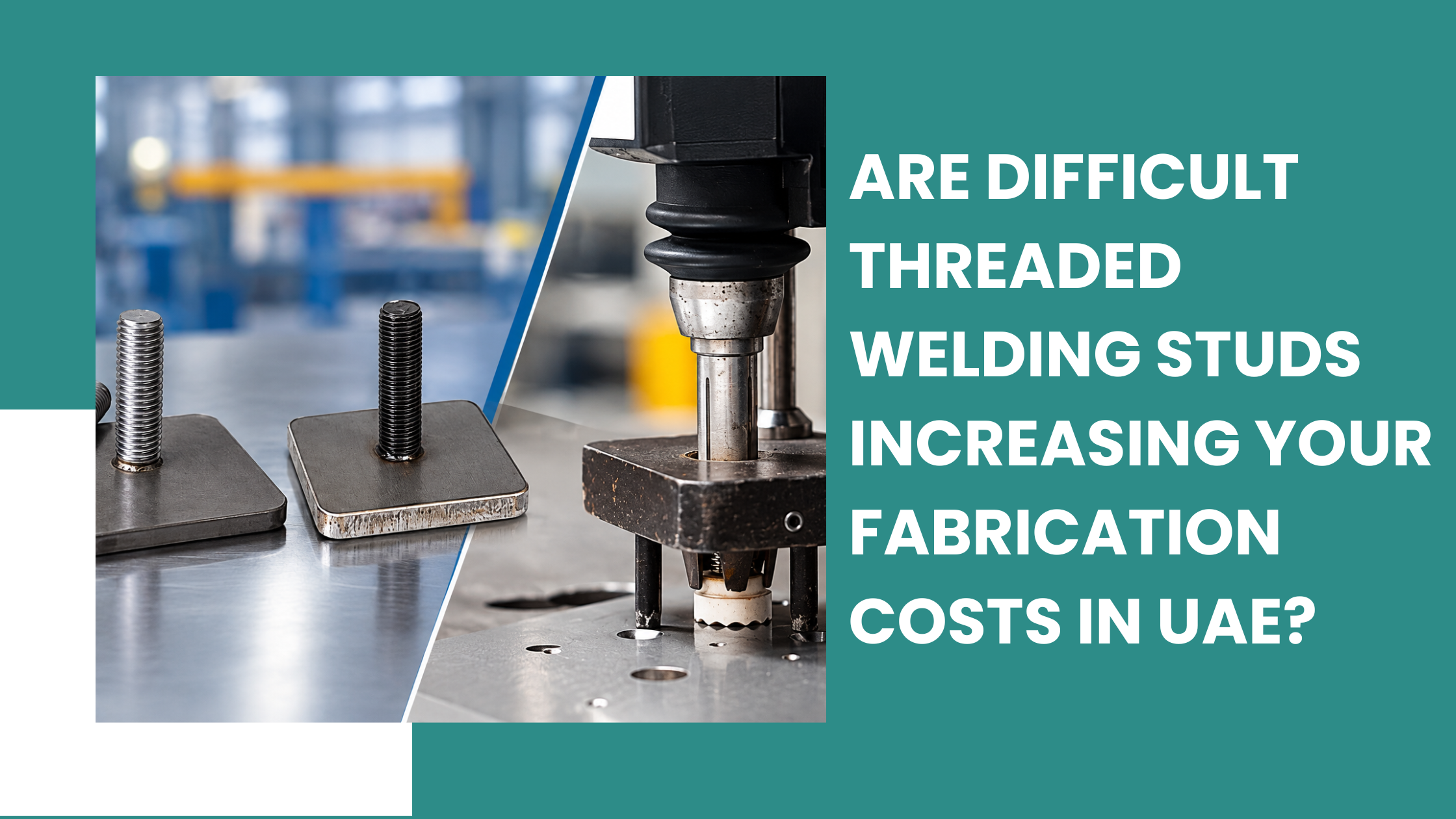
Threaded welding studs are widely used in steel fabrication for creating reliable attachment points without drilling holes or using conventional mechanical fasteners. They are found in structural steelwork, industrial equipment, tanks, vessels, insulation applications and other fabricated components.
For UAE fabricators, however, the actual cost of a threaded stud goes beyond its purchase price. Incorrect specifications, inconsistent welding parameters, poor surface preparation, damaged threads and repeated rework can increase labour hours and reduce production efficiency.
If your workshop is experiencing recurring stud-welding problems, it may be time to examine whether your Threaded Welding Studs in UAE are contributing to hidden fabrication costs.
What Makes a Threaded Welding Stud Difficult to Weld?
Several factors can affect stud-welding performance. Stud diameter, length, material, thread configuration and the parent-metal condition all need to match the application.
ISO 13918 covers requirements for studs used in stud welding, including dimensions, materials and mechanical properties. It also identifies different stud configurations, including fully threaded, partially threaded and reduced-shaft threaded studs.
A technically suitable stud should therefore be selected according to the welding process, base material, required attachment and project specification rather than simply choosing the lowest-cost option.
How Poor Stud Selection Can Increase Rework
A stud that is unsuitable for the application can create problems throughout the fabrication process. A poor match between the stud and parent material may contribute to inconsistent attachment or additional corrective work.
For example, repeated problems can result in:
- Replacing defective studs
- Additional welding cycles
- Extra inspection
- Grinding or cleaning
- Damaged components
- Delays during assembly
The real cost can be calculated as:
Stud purchase cost + welding time + labour + inspection + rework + wastage = actual installation cost
This approach gives fabrication managers a more realistic understanding of stud-welding expenses.
Are Welding Parameters Causing the Problem?
Even when the correct stud is selected, incorrect welding parameters can affect results.
Depending on the welding process and equipment, important variables can include welding current, welding time, stud diameter, lift, plunge and surface condition.
Incorrect settings can result in inconsistent weld collars, excessive spatter or inadequate attachment. Operators should therefore follow the equipment manufacturer’s recommended parameters for the specific stud and application instead of using identical settings across different stud sizes.
For production environments, documenting successful settings for frequently used stud specifications can also improve repeatability between operators and shifts.
Surface Preparation Can Make a Significant Difference
The condition of the parent material is another important factor.
Steel plates may contain:
- Mill scale
- Rust
- Paint
- Oil or grease
- Moisture
- Protective coatings
- Galvanizing
Contamination around the welding location can interfere with the welding process. Proper preparation should therefore be part of the fabrication procedure, particularly when consistent stud attachment is required.
A simple inspection checklist before welding can help operators identify whether recurring failures are related to material condition rather than the welding equipment itself.
How Difficult Studs Affect Production Time
Small delays become significant when hundreds or thousands of studs are installed.
Consider an illustrative example: if a fabrication project requires 1,000 studs and an additional 20 seconds is spent positioning, correcting or replacing each stud, that represents approximately 5.6 additional labour hours.
This does not include the cost of rejected components, inspection or material wastage.
For high-volume fabrication, tracking the number of studs installed per shift, rejection rates and average installation time can help identify where productivity is being lost.
Thread Damage Can Create Problems During Assembly
A successful weld does not necessarily mean the complete fastening operation is successful.
The threaded portion must remain usable for subsequent assembly. Weld spatter, incorrect positioning or physical damage can affect thread engagement and make it difficult to install nuts or other components.
Where threaded studs are used repeatedly in a production line, fabricators should monitor both weld quality and thread condition as part of their quality-control process.
Are You Using the Right Stud-Welding Process?
Different stud-welding applications may require different processes.
Drawn arc stud welding can be used for applications involving heavier sections and larger studs, while capacitor-discharge or tip-ignition approaches can be suitable for certain applications involving thinner materials and short welding cycles.
ISO 13918 recognizes stud-welding techniques including drawn arc and short-cycle/tip-ignition processes.
The appropriate process depends on the stud, parent material, thickness, diameter, production requirements and equipment configuration.
When Does Manual Stud Welding Become a Bottleneck?
Manual stud welding can be practical for low-volume or varied fabrication work. However, repetitive high-volume production can expose limitations.
Warning signs include:
- Large numbers of studs installed every shift
- Frequent positioning errors
- Different operators using inconsistent settings
- Increasing rejection rates
- Repeated inspection failures
- Excessive time spent on rework
At this stage, fabricators can evaluate whether semi-automated or automated stud-welding equipment would improve process consistency.
Can Welding Automation Reduce Process Variability?
Automation can help control repetitive welding operations by providing more consistent positioning and repeatable welding cycles.
A Welding Automation Equipment Supplier in UAE can assess factors such as production volume, stud dimensions, component geometry, welding process and required positioning accuracy before recommending an appropriate solution.
Automation is not necessarily required for every fabrication project. The decision should be based on measurable production requirements and the potential improvement in consistency, cycle time and quality control.
What About Insulation Pin Welding?
Insulation pins are another important application within industrial fabrication. They can be used for attaching insulation materials to metal surfaces in equipment and industrial applications.
ISO 13918 includes insulation pins or nails among the stud types covered by the standard.
For companies sourcing these products, working with an experienced Insulation pin supplier in Dubai can help ensure that pin dimensions, material and application requirements are properly matched with the welding equipment and process.
How Should UAE Fabricators Control Stud-Welding Costs?
Before changing suppliers or equipment, track the main cost factors:
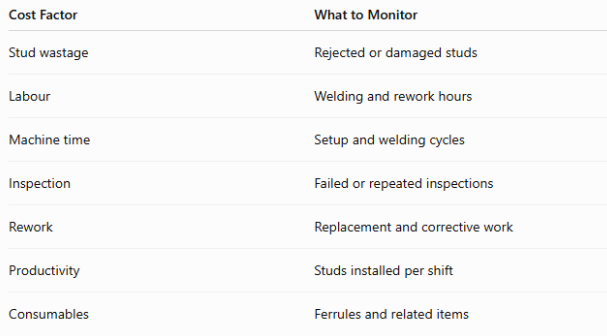
This data can help determine whether the problem is related to stud selection, welding parameters, equipment condition or operator technique.
Choosing the Right Threaded Welding Studs in UAE
Before purchasing threaded welding studs, consider the diameter, length, thread configuration, material, base-metal compatibility, welding process and project requirements.
The cheapest stud is not necessarily the lowest-cost option when installation difficulties and rework are included.
Conclusion
Difficult threaded welding studs can increase fabrication costs through more than material wastage. Additional labour, slower production, rework, inspection requirements and assembly problems can all contribute to the final cost.
For UAE steel fabricators, monitoring stud rejection, welding time and rework can reveal where these hidden costs are occurring. Selecting appropriate Threaded Welding Studs, using suitable welding parameters and evaluating automation where production volumes justify it can help create a more controlled and repeatable fabrication process.
To learn more, click: When Should You Upgrade to a Welding Manipulator Machine in UAE?

Related Posts