Tank rotators are an important part of modern steel fabrication, particularly when manufacturers need to weld cylindrical and circular components accurately and efficiently. In the UAE, where industries such as oil & gas, pressure vessel manufacturing, pipeline fabrication, water storage and structural steel rely on fabricated metal components, controlled handling of large cylindrical workpieces can significantly improve welding productivity.
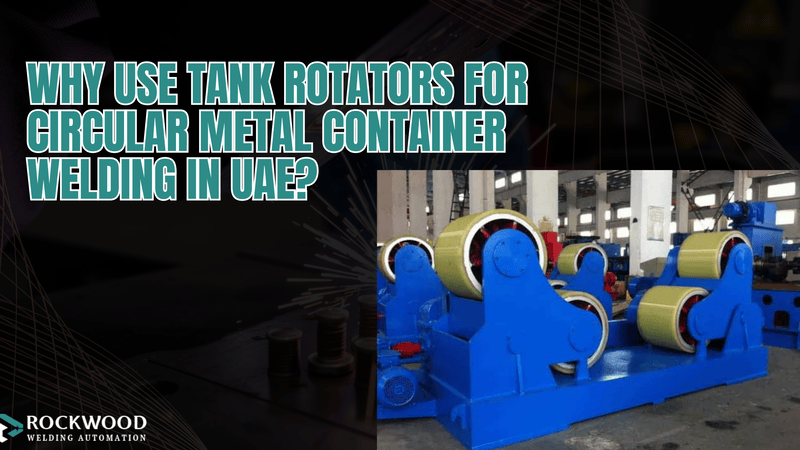
A tank rotator, also known as a welding rotator or turning rolls, supports a cylindrical workpiece and rotates it at a controlled speed while the welding operation is performed. Instead of repeatedly repositioning a heavy tank or vessel, the rotator allows the fabricator to bring the welding area into a convenient working position.
What Is a Tank Rotator?
A tank rotator is a mechanical system consisting of rollers, drive units and controls designed to support and rotate cylindrical workpieces.
Depending on the machine configuration, tank rotators in UAE can be self-aligning or conventional, with capacities and roller arrangements selected according to the workpiece diameter, weight and application.
For steel fabrication companies, this equipment can be used for:
- Pressure vessels
- Storage tanks
- Oil and gas vessels
- Pipeline sections
- Wind tower components
- Cylindrical steel structures
- Large pipes and fabricated containers
The main objective is simple: rotate the workpiece smoothly while keeping it stable during welding.
Why Are Tank Rotators Useful for Welding?
1. More Consistent Welding Positions
Welding long circumferential joints manually can require the operator to work in several positions around the workpiece. A rotator continuously turns the component, allowing the welding area to remain within a more manageable working position.
This can help improve consistency in welding speed, torch movement and joint access.
For fabrication involving pressure vessels, quality control is particularly important. ASME BPVC Section VIII, for example, covers requirements related to the design, fabrication, inspection, testing and certification of pressure vessels, including welding-related fabrication requirements.
2. Better Productivity for Cylindrical Components
Handling a large steel vessel with cranes or manual positioning after every welding section can consume valuable production time.
A tank rotator provides controlled rotation, reducing the need to repeatedly reposition the workpiece. This becomes especially useful when fabricators are producing multiple tanks or vessels with similar dimensions.
For production environments, the benefit is not simply faster welding. Less repositioning can mean better workflow, reduced handling interruptions and improved utilization of welding equipment.
3. Suitable for Large and Heavy Workpieces
Circular steel containers can become extremely heavy as their diameter, length and wall thickness increase.
A properly selected welding rotator distributes the workpiece load across its roller system while providing controlled movement. However, the maximum load, diameter range and speed must always be checked against the manufacturer’s specifications before selecting equipment.
This is particularly important for UAE fabrication projects involving large pressure vessels, storage tanks and industrial structures.
4. Improved Operator Ergonomics
Large cylindrical workpieces can force welders to work in uncomfortable positions when the component cannot be easily rotated.
With a welding rotator, the operator can position the joint more conveniently by rotating the vessel rather than physically moving around the entire component.
Better positioning can support more comfortable working conditions and help maintain consistent welding technique over longer fabrication cycles.
Tank Rotators for Pressure Vessel Manufacturing
Pressure vessel fabrication demands careful control of welding, inspection and documentation.
ASME Section VIII Division 1 applies to pressure vessels operating at internal or external pressures exceeding 15 psig and includes requirements associated with fabrication, welding, inspection and testing.
A tank rotator does not make a vessel compliant by itself. Instead, it is one production tool within a broader fabrication and quality-control process.
Welding procedures, qualified personnel, material traceability, inspection and testing must still follow the applicable project specification and governing code.
For manufacturers following ISO-based welding quality systems, ISO 3834 provides different levels of quality requirements for fusion welding of metallic materials, including comprehensive, standard and elementary requirements.
Self-Aligning vs Conventional Welding Rotators
For fabrication companies handling cylindrical workpieces of varying diameters, self-aligning rotators can offer an important operational advantage.
The roller arrangement can accommodate changes in workpiece diameter without requiring the same level of manual adjustment associated with some conventional configurations.
When choosing between systems, fabricators should consider:
- Maximum workpiece weight
- Minimum and maximum diameter
- Vessel length
- Roller capacity
- Rotation speed
- Motor power
- Control system
- Required welding process
- Manual or automated welding requirements
- Workshop floor space
The correct combination depends on the fabrication application rather than simply selecting the highest-capacity machine.
Tank Rotators for UAE Steel Fabrication
The UAE’s industrial fabrication environment includes applications across oil & gas, energy, pressure vessel manufacturing, pipelines, water infrastructure and heavy engineering. These applications frequently involve cylindrical or circular steel components where controlled rotation can simplify fabrication.
For UAE workshops, equipment selection should also account for the actual production environment, including available floor space, workpiece dimensions, lifting arrangements and expected production volume.
A rotator designed for occasional fabrication may have very different requirements from one used continuously in a high-volume production line.
How to Choose the Right Tank Rotator
Before investing in a welding rotator, fabricators should provide the equipment supplier with accurate information about the workpiece.
At minimum, specify:
Workpiece weight + diameter + length + material + welding application + production requirements.
It is also important to determine whether the rotator will be used with manual welding, submerged arc welding, automatic welding or another mechanized process.
For automated production, integration with welding controls, travel systems and other automation equipment may be considered.
Final Thoughts
For steel fabrication companies in the UAE, tank rotators are an essential part of efficient welding automation, providing controlled and reliable rotation of cylindrical workpieces during fabrication. They help improve access to circumferential welds, reduce unnecessary repositioning, support consistent welding operations, and make the handling of large tanks, vessels, pipes, and other round workpieces more efficient.
Choosing the right rotator requires careful consideration of the workpiece weight, diameter, length, rotation speed, and welding process. The right combination of capacity and control can help fabricators achieve a smoother, more productive welding workflow.
Looking for reliable welding automation solutions in the UAE? Talk to Rockwood Welding Automation to find the right welding rotator for your workpiece specifications and production requirements—and take your circular welding operations to the next level.
To learn more, click: 10 Signs Your UAE Factory Is Ready for a Robotic Welding Machine

Related Posts