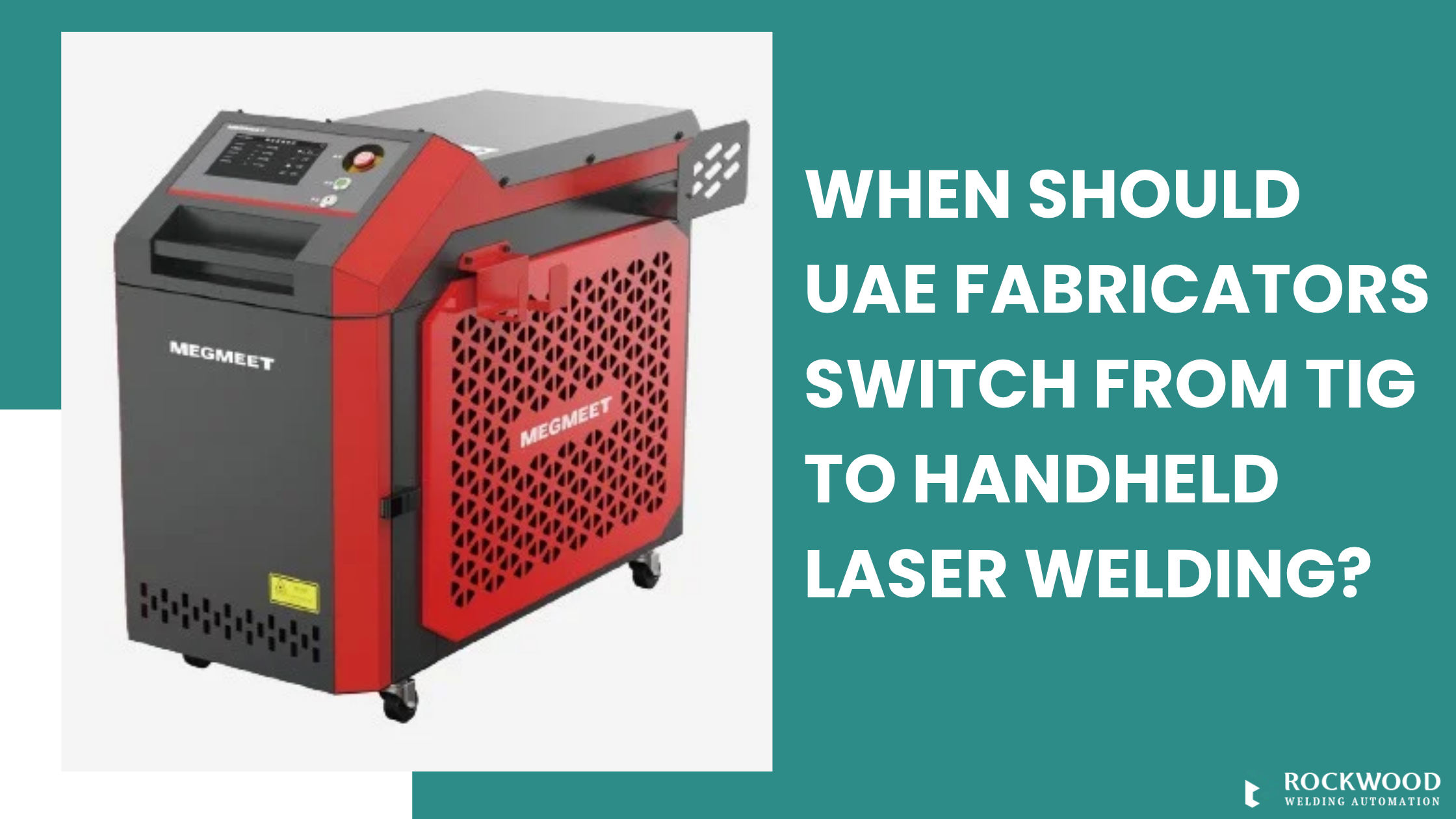
Choosing the right welding process can directly affect production speed, finishing costs, and weld quality. For fabrication companies in the UAE, TIG welding remains a reliable choice for precision work, but growing production demands are encouraging workshops to explore newer technologies. A Handheld Laser Welding Machine can offer advantages in suitable applications, particularly when working with thin stainless steel sheets, visible welds, and repeat-production components.
However, switching from TIG to laser welding requires more than comparing machine specifications. Fabricators must consider material thickness, joint design, weld quality, operator training, and workplace safety before making an investment.
Understanding TIG Welding and Handheld Laser Welding
TIG welding uses an electric arc between a non-consumable tungsten electrode and the workpiece. It provides precise control over the weld pool and is widely used for stainless steel, aluminium, and other metals requiring careful welding.
Handheld laser welding machines in UAE use a concentrated laser beam to join metal components. Depending on the machine, material, and application, it can provide higher welding speeds and lower heat input than conventional TIG welding.
The concentrated energy can reduce distortion in suitable thin-sheet applications. Laser welding may also reduce the amount of post-weld grinding required, particularly where a consistent surface appearance is important.
Nevertheless, results depend on material thickness, joint preparation, laser settings, and operator skill. TIG welding may remain the better choice for specialised joints, demanding root passes, or applications governed by established welding procedures.
Five Signs Your Workshop Should Consider a Handheld Laser Welding Machine
1. TIG Welding Is Slowing Down Production
If your workshop regularly produces stainless steel cabinets, enclosures, sheet-metal assemblies, or similar components, TIG welding may limit output on certain repetitive joints.
A Handheld Laser Welding Machine can potentially reduce welding time on suitable applications. Before purchasing one, compare the complete production cycle, including setup, welding, handling, finishing, and inspection.
2. Thin Metal Components Are Experiencing Distortion
Excessive heat can cause warping and dimensional changes in thin stainless steel sheets. Correct welding parameters and joint preparation help control this problem, but some components may still require straightening or rework.
Laser welding’s concentrated heat input can reduce distortion in appropriate applications. Fabricators should test representative components to verify dimensional accuracy and confirm that the required weld quality is achieved.
3. Post-Weld Finishing Is Increasing Labour Costs
Grinding, polishing, and blending can add significant time to the production of visible stainless steel components.
Where laser welding produces an acceptable weld profile, it may reduce finishing requirements. However, the result depends on joint fit-up, material condition, welding parameters, and the required surface finish. Some applications will still need polishing or other finishing operations.
4. Customers Expect More Consistent Weld Appearance
Architectural metalwork, decorative stainless steel panels, commercial interiors, and equipment enclosures often require a uniform finish.
A properly configured laser welding process can help achieve consistent results on repeat-production work. Operators must still maintain suitable joint alignment, follow the recommended parameters, and inspect finished welds against project specifications.
5. Your Workshop Needs Higher Production Capacity
When orders increase, fabricators must decide whether to add labour, extend shifts, or improve production efficiency.
A handheld laser system may help increase output on suitable jobs. However, welding is only one part of production. Cutting, fit-up, material handling, inspection, and finishing must also have sufficient capacity to support higher throughput.
Which Fabrication Applications Benefit Most?
Handheld laser welding can be useful for selected stainless steel enclosures, sheet-metal components, decorative panels, light industrial assemblies, and other products involving suitable thicknesses and joint configurations.
For larger or repetitive assemblies, integrating welding equipment with a Welding positioner in UAE can improve access to different sides of a component and help maintain a convenient working position. A positioner rotates or tilts the workpiece, reducing the need for repeated manual repositioning.
A Welding manipulator in UAE can also support specialised welding operations by positioning or moving welding equipment in a controlled manner. Depending on the configuration, manipulators are often used for larger workpieces and repeatable welding paths.
These systems do not automatically make a handheld laser process fully automated. Their suitability depends on the machine design, required motion, workpiece dimensions, and safety arrangements.
When Should You Continue Using TIG Welding?
Switching completely to laser welding is not necessary for every fabrication workshop.
TIG remains valuable for complex joints, applications requiring precise manual control, and work where existing qualified welding procedures specify a particular process. Laser welding can also be sensitive to gaps and poor joint alignment, making accurate preparation important.
For pressure equipment, structural components, and other specification-driven applications, fabricators should confirm the applicable codes, procedure qualifications, customer approvals, and inspection requirements before changing welding processes.
A practical approach is to retain TIG for applications where it performs best and introduce laser welding for suitable production work.
How to Calculate the Return on Investment
The purchase price of a Handheld Laser Welding Machine should be evaluated alongside its operating and safety costs.
Consider the following factors:
- Equipment purchase, installation, and maintenance.
- Laser safety equipment, guarding, and controlled access.
- Operator training and consumables.
- Welding time and post-weld finishing costs.
- Rework, rejected components, and inspection expenses.
- Number of acceptable components produced per shift.
For a meaningful comparison, test both processes on the same component and calculate the total cost per accepted part. Include setup and finishing time rather than relying solely on advertised welding speeds.
Safety Considerations Before Switching
Laser welding introduces hazards that require specific controls. Direct or reflected laser radiation can cause serious eye and skin injuries, while welding fumes and fire risks also require attention.
Before operating a laser system, workshops should conduct a risk assessment, establish appropriate guarding or an enclosed work area, control access, provide suitable laser-rated protective equipment, and train operators. Ordinary welding PPE alone is not sufficient to ensure laser safety.
Equipment selection should include the manufacturer’s safety documentation, installation requirements, and guidance on maintenance and operator training.
Conclusion
A Handheld Laser Welding Machine can be a worthwhile investment for UAE fabricators seeking improved production efficiency, reduced distortion, and consistent finishing on suitable metal components. However, the right choice depends on the actual work being produced, the required weld quality, and the workshop’s safety capabilities.
By testing representative components, measuring total production costs, and evaluating complementary equipment such as a Welding positioner in UAE or Welding manipulator in UAE, fabricators can make an informed decision about integrating laser welding into their operations.
To learn more, click: 5 Signs Your Fabrication Business Needs an Automated Stud Welding Machine

Related Posts